


 |
| Credit: NASA/JPL-Caltech/UCLA |
Field of Science
-
-
Change of address9 months ago in Variety of Life
-
Change of address9 months ago in Catalogue of Organisms
-
-
Earth Day: Pogo and our responsibility1 year ago in Doc Madhattan

Showing posts with label WISE. Show all posts
Showing posts with label WISE. Show all posts
Messier 81 and Messier 82
WISE image of the spiral galaxies Messier 82 (seen edge-on at the top of the image) and Messier 81 (see face-on at the bottom of the image). M81 and M82 swept by one another a few hundred million years ago--triggering a burst of star formation in both--and will likely pass near each other again multiple times until they eventually merge into a single galaxy.
Sculptor Galaxy (NGC 253)
An infrared mosaic of the Sculptor galaxy (NGC 253)--the nearest starburst galaxy to the Milky Way--from WISE.

Red shows active side of infant stars heating up their dusty cocoons.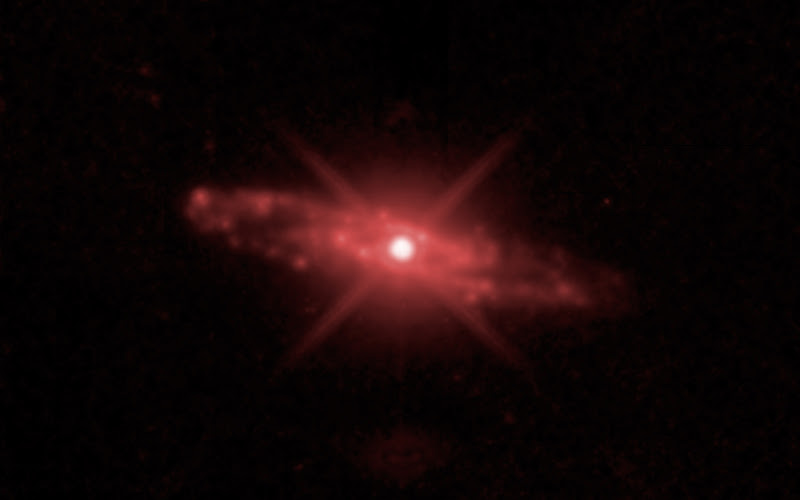
Green shows emerging young stars.
Blue shows stars of all ages.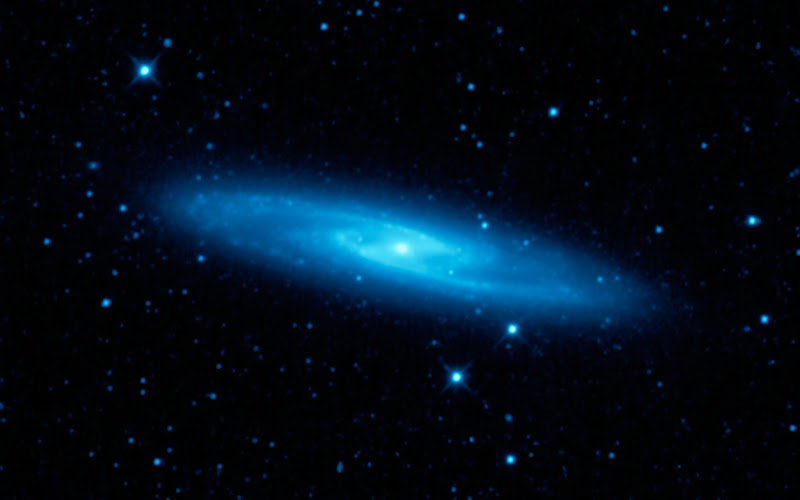 Credit: NASA/JPL-Caltech/WISE Team

Red shows active side of infant stars heating up their dusty cocoons.

Green shows emerging young stars.

Blue shows stars of all ages.
 Credit: NASA/JPL-Caltech/WISE Team
The Pleiades
WISE infrared mosaic of the Pleiades (Seven Sisters) star cluster.
 Credit: NASA/JPL-Caltech/WISE Team
 Credit: NASA/JPL-Caltech/WISE Team
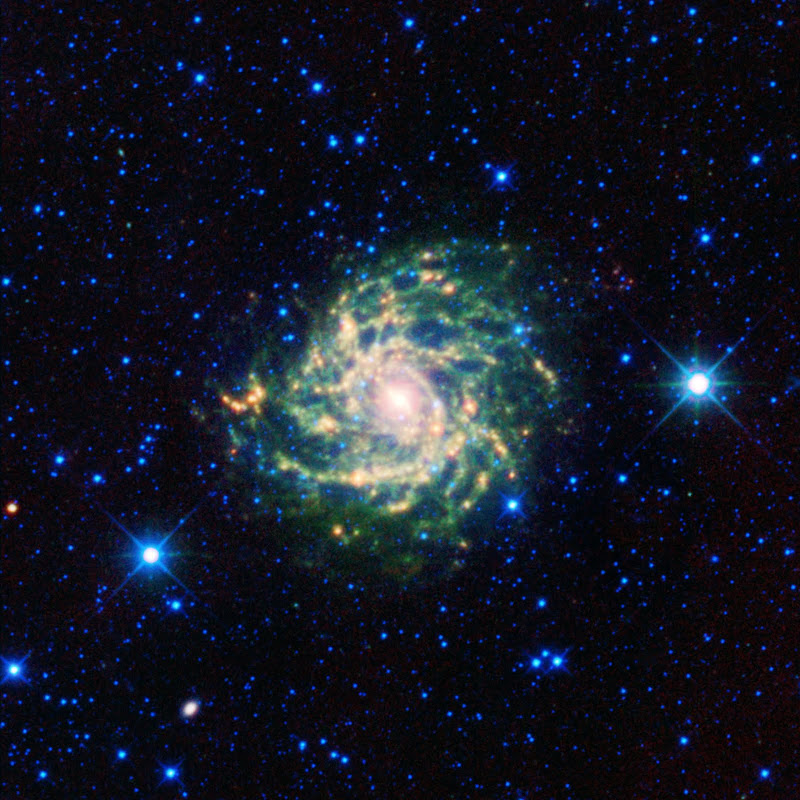
Hidden Galaxy No More
IC 342, also known as the "hidden galaxy" because of its location behind the veil of dust, gas and stars of the Milky Way, is brought into focus thanks to WISE's penetrating infrared view. IC 342 is shown in green, yellow and red. The blue stars in this image are those that reside within our Milky Way galaxy.
 Credit: NASA/JPL-Caltech/UCLA
 Credit: NASA/JPL-Caltech/UCLA
Infrared Image Of The Berkeley 59 Cluster Taken By WISE
The young stars in the Berkeley 59 star cluster are the blue dots right of center. The dense dust cloud from which they formed glows red where it is being compressed and heated by the newly formed stars, and possibly giving birth to an even younger second generation of stars. The green marks the edges of the nebula. The opening in the nebula was caused by a massive star going nova, blowing a hole in the cloud leaving behind this flowering remnant.
 Credit: NASA/JPL-Caltech/UCLA
 Credit: NASA/JPL-Caltech/UCLA
Andromeda Galaxy Among WISE's First Images
NASA released its first set of images from its Wide-field Infrared Survey Explorer, or WISE. Among them were these of the Andromeda Galaxy.
 The immense Andromeda galaxy, also known as Messier 31 or simply M31, is captured in full in this new image from NASA's Wide-field Infrared Survey Explorer, or WISE.


Credit: NASA/JPL-Caltech/UCLA
 The immense Andromeda galaxy, also known as Messier 31 or simply M31, is captured in full in this new image from NASA's Wide-field Infrared Survey Explorer, or WISE.

Credit: NASA/JPL-Caltech/UCLA
Subscribe to:
Comments (Atom)