NASA's Hubble Space Telescope has broken the distance limit for galaxies and uncovered a primordial population of compact and ultra-blue galaxies that have never been seen before...
 This is the deepest image of the Universe ever taken in near-infrared light by the NASA/ESA Hubble Space Telescope. The faintest and reddest objects (left inset) in the image are galaxies that correspond to lookback times of approximately 12.9 billion years to 13.1 billion years. No galaxies have been seen before at such early epochs. -- Press ReleaseNASA's
Chandra X-ray Observatory: New, very deep exposure of the supermassive black hole at the center of the Milky Way Galaxy (Sagittarius A*).
 Astronomers have long known that the supermassive black hole at the center of the Milky Way Galaxy, known as Sagittarius A* (or Sgr A* for short), is a particularly poor eater. The fuel for this black hole comes from powerful winds blown off dozens of massive young stars that are concentrated nearby. These stars are located a relatively large distance away from Sgr A*, where the gravity of the black hole is weak, and so their high-velocity winds are difficult for the black hole to capture and swallow. Scientists have previously calculated that Sgr A* should consume only about 1% of the fuel carried in the winds. However, it now appears that Sgr A* consumes even less than expected -- Press ReleaseNASA's
Spitzer Space Telescope has taken this infrared portrait of the Small Magellanic Cloud, revealing the stars and dust in this galaxy as never seen before. The Small Magellanic Cloud is a nearby satellite galaxy to our Milky Way galaxy, approximately 200,000 light-years away.
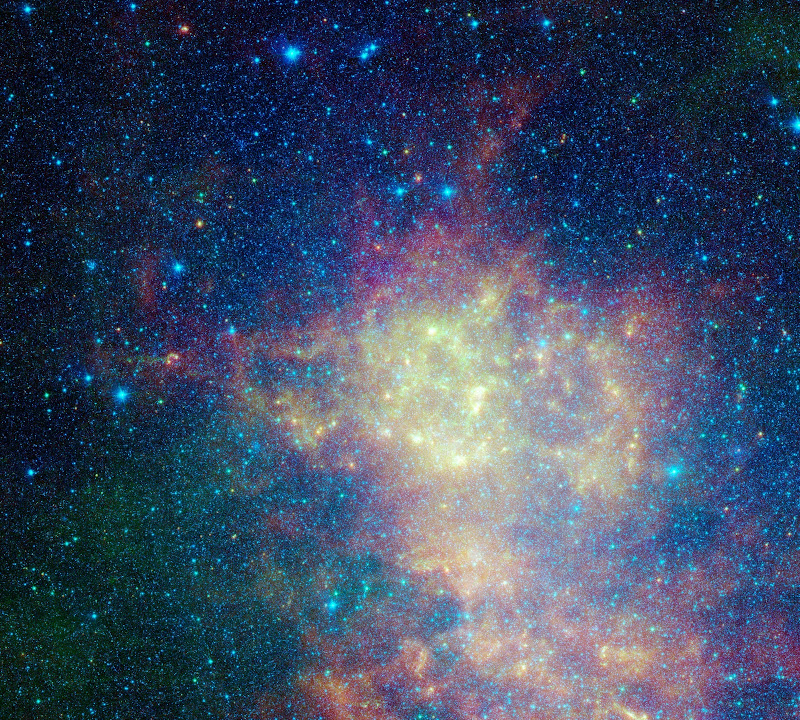 Infrared light is color-coded in the new picture, so that blue shows older stars, green shows organic dust and red highlights dust-enshrouded star formation. -- Press Release


 Credit: X-ray (NASA/CXC/MIT/C.Canizares, D.Evans et al), Optical (NASA/STScI), Radio (NSF/NRAO/VLA)


 In celebration of the International Year of Astronomy 2009, NASA's Great Observatories -- the Hubble Space Telescope, the Spitzer Space Telescope, and the Chandra X-ray Observatory -- have produced a matched trio of images of the central region of our Milky Way galaxy. Each image shows the telescope's different wavelength view of the galactic center region, illustrating the unique science each observatory conducts. Credit: NASA/JPL-Caltech/ESA/CXC/STScI
 Spitzer's infrared-light observations provide a detailed and spectacular view of the galactic center region. The swirling core of our galaxy harbors hundreds of thousands of stars that cannot be seen in visible light. These stars heat the nearby gas and dust. These dusty clouds glow in infrared light and reveal their often dramatic shapes. Some of these clouds harbor stellar nurseries that are forming new generations of stars. Like the downtown of a large city, the center of our galaxy is a crowded, active, and vibrant place. Credit: NASA, JPL-Caltech, E. Churchwell (University of Wisconsin), SSC, and STScI
 X-rays detected by Chandra expose a wealth of exotic objects and high-energy features. In this image, pink represents lower energy X-rays and blue indicates higher energy. Hundreds of small dots show emission from material around black holes and other dense stellar objects. A supermassive black hole -- some four million times more massive than the Sun -- resides within the bright region in the lower right. The diffuse X-ray light comes from gas heated to millions of degrees by outflows from the supermassive black hole, winds from giant stars, and stellar explosions. This central region is the most energetic place in our galaxy. Credit: NASA/CXC/UMass/D. Wang et al.
 Although best known for its visible-light images, Hubble also observes over a limited range of infrared light. The galactic center is marked by the bright patch in the lower right. Along the left side are large arcs of warm gas that have been heated by clusters of bright massive stars. In addition, Hubble uncovered many more massive stars across the region. Winds and radiation from these stars create the complex structures seen in the gas throughout the image. This sweeping panorama is one of the sharpest infrared pictures ever made of the galactic center region. Credit: NASA, ESA, Q.D. Wang (University of Massachusetts, Amherst), and STScI


