


 |
| Credit: NASA/JPL/University of Arizona/University of Leicester |
Field of Science
-
-
Change of address1 year ago in Variety of Life
-
Change of address1 year ago in Catalogue of Organisms
-
-
Earth Day: Pogo and our responsibility1 year ago in Doc Madhattan

Showing posts with label Saturn. Show all posts
Showing posts with label Saturn. Show all posts
Saturn's Southern Lights
This Cassini false-color composite image is of aurora emissions (in green) eminating from the Saturn's southern polar region.
Saturn South
Saturn with moons Tethys and Rhea from a southern perspective.
 Credit: NASA/JPL/Space Science Institute
 Credit: NASA/JPL/Space Science Institute

Enceladus
Blobs of warm ice that periodically rise to the surface and churn the icy crust on Saturn's moon Enceladus explain the quirky heat behavior and intriguing surface of the moon's south polar region, according to a new paper using data from NASA's Cassini spacecraft. -- Press Release
 Credit: NASA/JPL/Space Science Institute
 Credit: NASA/JPL/Space Science Institute
Saturn's Moons
Cassini imaging team has created a video collection of "mutual events," which occur when one moon passes in front of another, as seen from the spacecraft. -- Press Release
Below are two of the images used to create the videos.
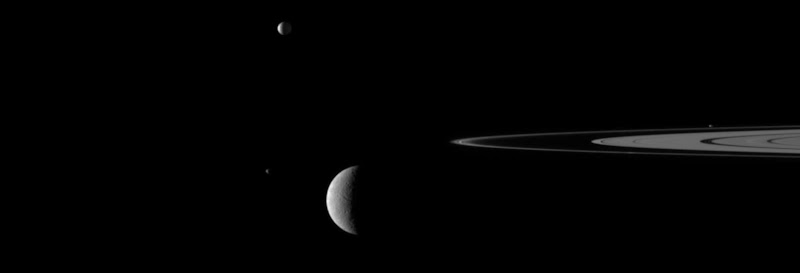
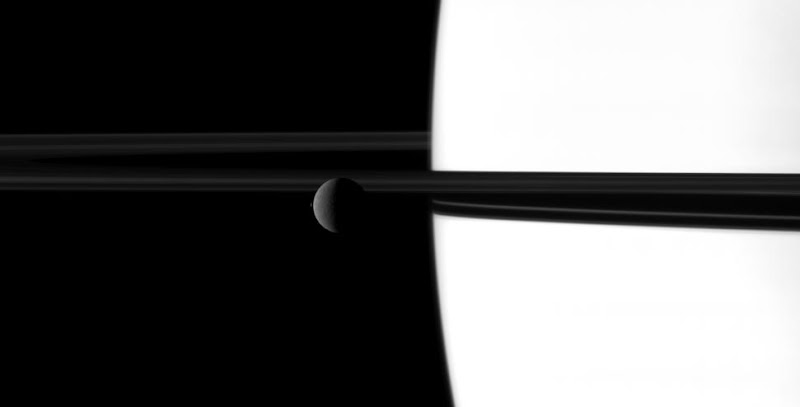
Images Credit: NASA/JPL/Space Science Institute
Below are two of the images used to create the videos.


Images Credit: NASA/JPL/Space Science Institute
Saturn's Largest Ring
This artist's conception shows a nearly invisible ring around Saturn -- the largest of the giant planet's many rings. It was discovered by NASA's Spitzer Space Telescope. The ring is so diffuse that it reflects little sunlight, or visible light that we see with our eyes. But its dusty particles shine with infrared light, or heat radiation, that Spitzer can see.
The artist's conception simulates an infrared view of the giant ring. Saturn appears as just a small dot from outside the band of ice and dust. The bulk of the ring material starts about six million kilometers (3.7 million miles) away from the planet and extends outward roughly another 12 million kilometers (7.4 million miles). The ring's diameter is equivalent to roughly 300 Saturns lined up side to side.
The inset shows an enlarged image of Saturn, as seen by the W.M. Keck Observatory at Mauna Kea, Hawaii, in infrared light. The ring, stars and wispy clouds are an artist's representation.

This video showcases the Saturnian system, beginning with the planet itself and panning out to its newest addition -- an enormous ring discovered in infrared light by NASA's Spitzer Space Telescope. Click on the image for the movie.

This artist's conception shows a nearly invisible ring around Saturn — the largest of the giant planet's many rings. It was discovered by NASA's Spitzer Space Telescope. The ring is huge, and far from the gas planet and the rest of its majestic rings.
The bulk of the ring material starts about six million kilometers (3.7 million miles) away from the planet and extends outward roughly another 12 million kilometers (7.4 million miles). The diameter of the ring is equivalent to 300 Saturns lined up side to side. The ring is thick too -- it's about 20 times as thick as the diameter of the planet. In fact, the entire volume of the ring is big enough to hold one billion Earths!

 This picture highlights a slice of Saturn's largest ring. The ring (the red band in the below figure) was discovered by NASA's Spitzer Space Telescope, which detected infrared light, or heat, from the dusty ring material. Spitzer viewed the ring edge-on from its Earth-trailing orbit around the sun.
The ring has a diameter equivalent to 300 Saturns lined up side to side. And it's thick too -- about 20 Saturns could fit into its vertical height. The ring is tilted about 27 degrees from Saturn's main ring plane.
The Spitzer data were taken by its multiband imaging photometer and show infrared light with a wavelength of 24 microns.
The picture of Saturn was taken by NASA's Hubble Space Telescope.

The artist's conception simulates an infrared view of the giant ring. Saturn appears as just a small dot from outside the band of ice and dust. The bulk of the ring material starts about six million kilometers (3.7 million miles) away from the planet and extends outward roughly another 12 million kilometers (7.4 million miles). The ring's diameter is equivalent to roughly 300 Saturns lined up side to side.
The inset shows an enlarged image of Saturn, as seen by the W.M. Keck Observatory at Mauna Kea, Hawaii, in infrared light. The ring, stars and wispy clouds are an artist's representation.

Credit: NASA/JPL-Caltech
This video showcases the Saturnian system, beginning with the planet itself and panning out to its newest addition -- an enormous ring discovered in infrared light by NASA's Spitzer Space Telescope. Click on the image for the movie.
Credit: NASA/JPL-Caltech
This artist's conception shows a nearly invisible ring around Saturn — the largest of the giant planet's many rings. It was discovered by NASA's Spitzer Space Telescope. The ring is huge, and far from the gas planet and the rest of its majestic rings.
The bulk of the ring material starts about six million kilometers (3.7 million miles) away from the planet and extends outward roughly another 12 million kilometers (7.4 million miles). The diameter of the ring is equivalent to 300 Saturns lined up side to side. The ring is thick too -- it's about 20 times as thick as the diameter of the planet. In fact, the entire volume of the ring is big enough to hold one billion Earths!

Credit: NASA/JPL-Caltech
 This picture highlights a slice of Saturn's largest ring. The ring (the red band in the below figure) was discovered by NASA's Spitzer Space Telescope, which detected infrared light, or heat, from the dusty ring material. Spitzer viewed the ring edge-on from its Earth-trailing orbit around the sun.
The ring has a diameter equivalent to 300 Saturns lined up side to side. And it's thick too -- about 20 Saturns could fit into its vertical height. The ring is tilted about 27 degrees from Saturn's main ring plane.
The Spitzer data were taken by its multiband imaging photometer and show infrared light with a wavelength of 24 microns.
The picture of Saturn was taken by NASA's Hubble Space Telescope.

Spitzer image credit: NASA/JPL-Caltech/Univ. of Virginia
Hubble image credit: NASA/ESA/STScI/AURA
Hubble image credit: NASA/ESA/STScI/AURA

A View of Earth from Saturn
This composite image taken by Cassini entitled "In Saturn's Shadow" showing Earth passing behind Saturn's outermost rings is among the finalists in NASA’s Earth Observatory's Favorite Image of the Day anniversary poll, and is my favorite. You have until the April 27th to vote. Credit: NASA/JPL/Space Science Institute Courtesy: CICLOPS
 Credit: NASA/JPL/Space Science Institute Courtesy: CICLOPS
Quadruple Saturn Moon Transit Snapped by Hubble
Saturn's comparatively paper-thin rings are tilted edge on to Earth every 15 years. Because the orbits of Saturn's major satellites are in the ring plane, too, this alignment gives astronomers a rare opportunity to capture a truly spectacular parade of celestial bodies crossing the face of Saturn. Leading the parade is Saturn's giant moon Titan – larger than the planet Mercury. The frigid moon’s thick nitrogen atmosphere is tinted orange with the smoggy byproducts of sunlight interacting with methane and nitrogen. Several of the much smaller icy moons that are closer in to the planet line up along the upper edge of the rings. Hubble’s exquisite sharpness also reveals Saturn's banded cloud structure. -- HubbleSite

Subscribe to:
Posts (Atom)