


 |
| Credit: NASA/JPL/University of Arizona/University of Leicester |
Field of Science
-
-
Change of address1 year ago in Variety of Life
-
Change of address1 year ago in Catalogue of Organisms
-
-
Earth Day: Pogo and our responsibility1 year ago in Doc Madhattan

Showing posts with label Solar System. Show all posts
Showing posts with label Solar System. Show all posts
Saturn's Southern Lights
This Cassini false-color composite image is of aurora emissions (in green) eminating from the Saturn's southern polar region.
Saturn South
Saturn with moons Tethys and Rhea from a southern perspective.
 Credit: NASA/JPL/Space Science Institute
 Credit: NASA/JPL/Space Science Institute
NASA's Solar Dynamics Observatory
Two of the just released "First Light" images from NASA's new space telescope, the Solar Dynamics Observatory.
 Prominence taken by the Solar Dynamics Observatory
 Full-disk multiwavelength extreme ultraviolet image of the sun taken by the Solar Dynamics Observatory
 Prominence taken by the Solar Dynamics Observatory
 Full-disk multiwavelength extreme ultraviolet image of the sun taken by the Solar Dynamics Observatory
Crescent Earth
 Illuminated crescent of Earth showing part of South America and Antarctica. Credits: ESA ©2009 MPS for OSIRIS Team MPS/UPD/LAM/IAA/RSSD/INTA/UPM/DASP/IDA
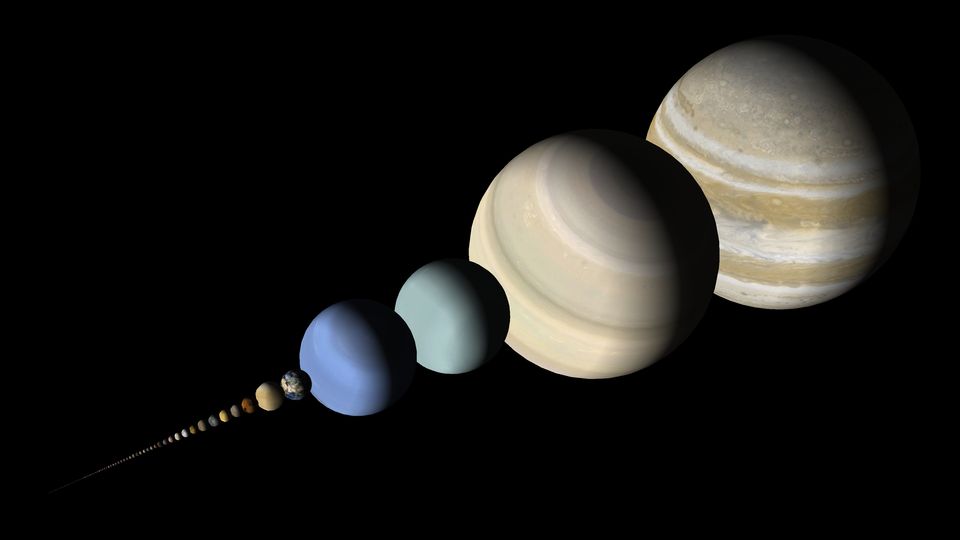
The Solar System...to Scale
 |
| A collection of artist's impressions and photo illustrations of the solar system. |
 All asteroids and comets visited by spacecraft as of November 2010. Credits: Montage by Emily Lakdawalla. Ida, Dactyl, Braille, Annefrank, Gaspra, Borrelly: NASA / JPL / Ted Stryk. Steins: ESA / OSIRIS team. Eros: NASA / JHUAPL. Itokawa: ISAS / JAXA / Emily Lakdawalla. Mathilde: NASA / JHUAPL / Ted Stryk. Lutetia: ESA / OSIRIS team / Emily Lakdawalla. Halley: Russian Academy of Sciences / Ted Stryk. Tempel 1, Hartley 2: NASA / JPL / UMD. Wild 2: NASA / JPL.

Moons of Our Solar System. This photo illustration shows selected moons of our solar system at their correct relative sizes to each other and to Earth. Pictured are Earth's moon; Jupiter's Callisto, Ganymede, Io and Europa; Saturn's Iapetus, Enceladus, Titan, Rhea, Mimas, Dione and Tethys; Neptune's Triton; Uranus' Miranda, Titania and Oberon and Pluto's Charon. Credit: NASA.

Moons of the Solar System. A selection of our solar system's natural satellites are shown here to scale compared to the Earth and its moon. Credit: NASA.

Sedna Size Comparison. The artist's rendition shows the planet-like object, dubbed 'Sedna,' in relation to other bodies in the Solar System, including Earth and its Moon; Pluto; and Quaoar, a planetoid beyond Pluto that was until now the largest known object beyond Pluto. The diameter of Sedna is slightly smaller than Pluto's but likely somewhat larger than Quaoar. Image Credit: NASA/JPL-Caltech/R. Hurt (SSC-Caltech)

Relative sizes of the 25 solar system objects smaller than the earth. Source: Wikipedia.


Terrestrial Planet Sizes. The terrestrial planets are the four innermost planets in the solar system; Mercury, Venus, Earth, and Mars. They are called terrestrial because they have a compact, rocky surface like the Earth's. The planets Venus, Earth, and Mars have significant atmospheres, while Mercury has almost none. This diagram shows the approximate relative sizes of the terrestrial planets. Distances are not to scale. Image Credit: Lunar and Planetary Institute.
 |
| The Relative Sizes of the Largest Solar System Objects - in the following order (to scale): Jupiter, Saturn, Uranus, Neptune, Earth, Venus, Mars, Ganymede, Titan, Mercury, Callisto, Io, The Moon, Europa, Triton, Eris, Pluto. Credit: Larry McNish. Source: The RASC Calgary Centre. |

100 Largest Objects in the Solar System. Source: Universe Sandbox

Rough visual comparison of Jupiter, Earth, and the Great Red Spot. Source: Wikipedia.


Gas Planet Sizes. Jupiter, Saturn, Uranus, and Neptune are known as the jovian (Jupiter-like) planets because they are all gigantic compared with Earth, and they have a gaseous nature like Jupiter's. The jovian planets are also referred to as the gas giants, although some or all of them might have small solid cores. This diagram shows the approximate relative sizes of the jovian planets. Image Credit: Lunar and Planetary Institute.

All Planet Sizes. This illustration shows the approximate sizes of the planets relative to each other. Outward from the Sun, the planets are Mercury, Venus, Earth, Mars, Jupiter, Saturn, Uranus, Neptune, and Pluto. Jupiter's diameter is about 11 times that of the Earth's and the Sun's diameter is about 10 times Jupiter's. Pluto's diameter is slightly less than one-fifth of Earth's. The planets are not shown at the appropriate distance from the Sun. Image Credit: Lunar and Planetary Laboratory

Title: Eight Planets and New Solar System Designations. Credit: International Astronomical Union. Source: APOD August 28, 2006.

w/o Designations. Credit: The International Astronomical Union/Martin Kornmesser. Source: HEIC.

This artist’s impression shows the supergiant star Betelgeuse as it was revealed thanks to different state-of-the-art techniques on ESO’s Very Large Telescope, which allowed two independent teams of astronomers to obtain the sharpest ever views of the supergiant star Betelgeuse. They show that the star has a vast plume of gas almost as large as our Solar System and a gigantic bubble boiling on its surface. These discoveries provide important clues to help explain how these mammoths shed material at such a tremendous rate. The scale in units of the radius of Betelgeuse as well as a comparison with the Solar System is also provided. Credit: ESO


Diagram of our location in the Local Supercluster in a series of five star maps that show from left to right our location in the Solar System, in the Sun's neighborhood of stars, in the local area of the Milky Way galaxy, in the Local Group of galaxies, and in the Supercluster of galaxies. Credit: Wikipedia.

50 Years of Space Exploration

The first attempts to reach Mars (1960) and Venus (1961) failed, yet triumph followed quickly. Of the nearly 200 solar, lunar, and interplanetary missions depicted on this map, most have been Earth's closest neighbors. As rocketry, navigation, and imaging have become ever more capable and reliable, the planets and many of their moons have been examined in detail. The New Horizons mission to Pluto is under way, as is the MESSENGER mission to Mercury. Others not yet launched, perhaps not yet dreamed, await. Art by Sean McNaughton, National Geographic Staff; Samuel Velasco, 5W Infographics. Sources: NASA; Chris Gamble. Sun, asteroid, and comet images: NASA/JPL.
Subscribe to:
Posts (Atom)