


 Credit: NASA/JPL/Space Science Institute
Field of Science
-
-
Change of address1 year ago in Variety of Life
-
Change of address1 year ago in Catalogue of Organisms
-
-
Earth Day: Pogo and our responsibility1 year ago in Doc Madhattan

Showing posts with label Natural Satellites. Show all posts
Showing posts with label Natural Satellites. Show all posts
Saturn South
Saturn with moons Tethys and Rhea from a southern perspective.
 Credit: NASA/JPL/Space Science Institute
Credit: NASA/JPL/Space Science Institute
Images In The Raw #3
This shot of Saturn's moon Enceladus was captured by Cassini on April 26, 2010.
 Credit: NASA/JPL/Space Science Institute
Spiral Galaxy M51 and companion galaxy NGC 5195.
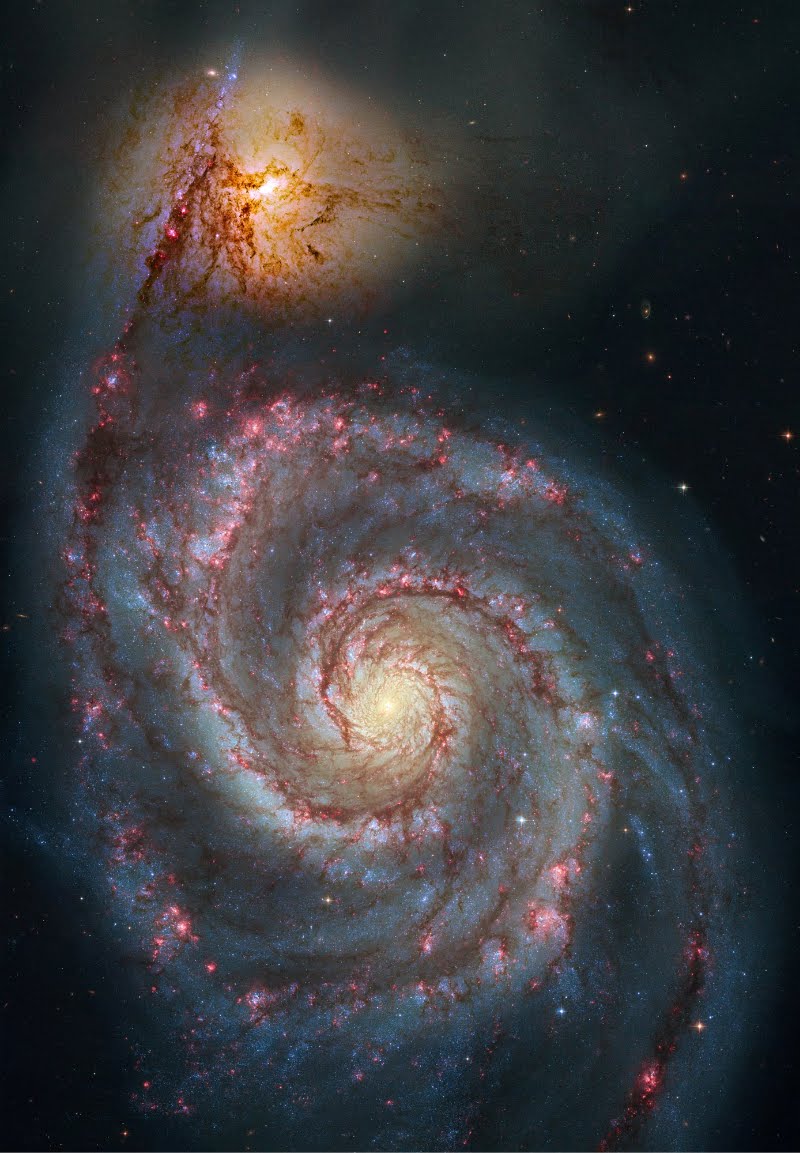 Credit: S. Beckwith (STScI), Hubble Heritage Team, (STScI/AURA), ESA, NASA
 Credit: NASA/JPL/Space Science Institute
Spiral Galaxy M51 and companion galaxy NGC 5195.
 Credit: S. Beckwith (STScI), Hubble Heritage Team, (STScI/AURA), ESA, NASA

Enceladus
Blobs of warm ice that periodically rise to the surface and churn the icy crust on Saturn's moon Enceladus explain the quirky heat behavior and intriguing surface of the moon's south polar region, according to a new paper using data from NASA's Cassini spacecraft. -- Press Release
 Credit: NASA/JPL/Space Science Institute
 Credit: NASA/JPL/Space Science Institute
Saturn's Moons
Cassini imaging team has created a video collection of "mutual events," which occur when one moon passes in front of another, as seen from the spacecraft. -- Press Release
Below are two of the images used to create the videos.
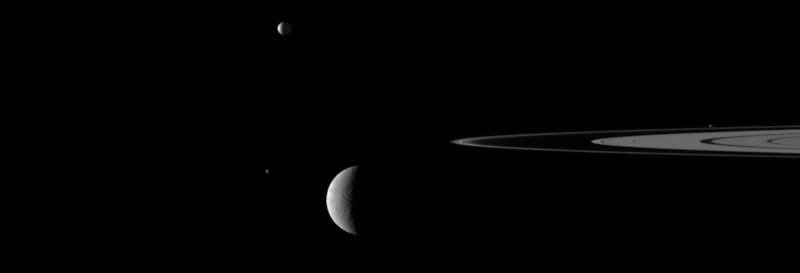
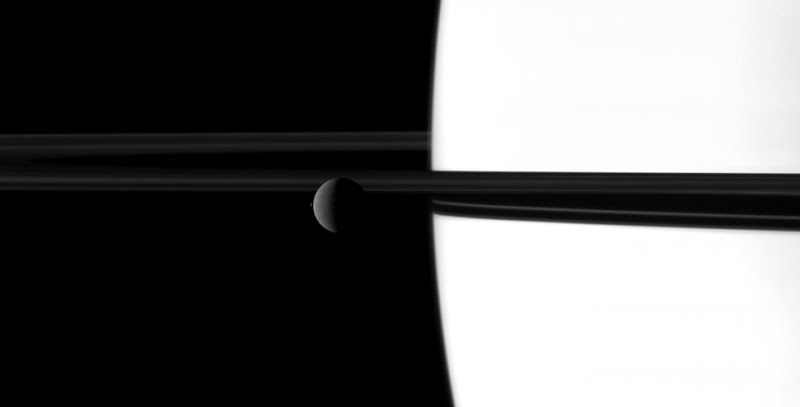
Images Credit: NASA/JPL/Space Science Institute
Below are two of the images used to create the videos.


Images Credit: NASA/JPL/Space Science Institute
Earth, 1966
NASA released a newly restored 42-year-old image of Earth on Thursday. The Lunar Orbiter 1 spacecraft took the iconic photograph of Earth rising above the lunar surface in 1966. Credit: NASA/Lunar Orbiter Image Recovery Project (LOIRP)

Quadruple Saturn Moon Transit Snapped by Hubble
Saturn's comparatively paper-thin rings are tilted edge on to Earth every 15 years. Because the orbits of Saturn's major satellites are in the ring plane, too, this alignment gives astronomers a rare opportunity to capture a truly spectacular parade of celestial bodies crossing the face of Saturn. Leading the parade is Saturn's giant moon Titan – larger than the planet Mercury. The frigid moon’s thick nitrogen atmosphere is tinted orange with the smoggy byproducts of sunlight interacting with methane and nitrogen. Several of the much smaller icy moons that are closer in to the planet line up along the upper edge of the rings. Hubble’s exquisite sharpness also reveals Saturn's banded cloud structure. -- HubbleSite

Mars' Moons: Deimos and Phobos
The average diameters of Deimos and Phobos are 12 and 22 km respectively. Both moons are misshapen because their low gravity (1/1000th of Earth's) is insufficient to pull them into spheres.
Hypotheses of the formation of Phobos and Deimos range from Mars impact remnants to captured asteroids (due to their similar size and composition to many asteroids).
 Deimos - Credit: NASA/JPL/University of Arizona
 Phobos - Credit: NASA/JPL/University of Arizona
 Phobos' Stickney Impact Crater - Credit: NASA/JPL/University of Arizona
Hypotheses of the formation of Phobos and Deimos range from Mars impact remnants to captured asteroids (due to their similar size and composition to many asteroids).
 Deimos - Credit: NASA/JPL/University of Arizona
 Phobos - Credit: NASA/JPL/University of Arizona
 Phobos' Stickney Impact Crater - Credit: NASA/JPL/University of Arizona
Subscribe to:
Posts (Atom)