


 |
| Credit: ESA/Hubble & NASA |
Field of Science
-
-
Change of address1 year ago in Variety of Life
-
Change of address1 year ago in Catalogue of Organisms
-
-
Earth Day: Pogo and our responsibility1 year ago in Doc Madhattan

Showing posts with label Star Clusters. Show all posts
Showing posts with label Star Clusters. Show all posts
The Open Star Cluster NGC 6611
Hubble image of the open star cluster NGC 6611, part of the Eagle Nebula, and together known as Messier 16.
NGC 6171
Sharp new image of Messier 107 (also known as NGC 6171) by the ESO's Wide Field Imager.
 |
| Credit: ESO/ESO Imaging Survey |
The Pleiades
WISE infrared mosaic of the Pleiades (Seven Sisters) star cluster.
 Credit: NASA/JPL-Caltech/WISE Team
 Credit: NASA/JPL-Caltech/WISE Team
Close Up Of The Milky Way's Most Massive Known Stars
The gas and dust of the giant galactic nebula NGC 3603 have been swept aside by the ultraviolet radiation and stellar winds of the star cluster at its heart. This is what's called a starburst region and is home to thousands of stars, include 3 Wolf-Rayet type stars, one of which was recently confirmed by observations from the VLT as the Milky Way's most massive known.
 Credit: NASA, ESA, R. O'Connell (University of Virginia), F. Paresce (National Institute for Astrophysics, Bologna, Italy), E. Young (Universities Space Research Association/Ames Research Center), the WFC3 Science Oversight Committee, and the Hubble Heritage Team (STScI/AURA)
 Credit: NASA, ESA, R. O'Connell (University of Virginia), F. Paresce (National Institute for Astrophysics, Bologna, Italy), E. Young (Universities Space Research Association/Ames Research Center), the WFC3 Science Oversight Committee, and the Hubble Heritage Team (STScI/AURA)
First Light
The ESO's new robotic telescope, TRAPPIST (TRAnsiting Planets and PlanetesImals Small Telescope), has taken three spectacular first light images of the spiral galaxy Messier 83, globular cluster Omega Centauri and the Tarantula Nebula. The 60-cm TRAPPIST based at the La Silla Observatory in Chile will study planetary systems via the duel tasking of studying local comets and through the detection and characterization of exoplanets. -- Press Release
 Credit: TRAPPIST/E. Jehin/ESO
 Credit: TRAPPIST/E. Jehin/ESO
 Credit: TRAPPIST/E. Jehin/ESO
 Credit: TRAPPIST/E. Jehin/ESO
 Credit: TRAPPIST/E. Jehin/ESO
 Credit: TRAPPIST/E. Jehin/ESO
Orion Nebula
This Spitzer Space Telescope image is of the Orion Nebula. Prominent features include the Trapezium star cluster, home to the hottest stars in the region (center right in the image below), and the dark areas center left are the densest parts of the dust cloud that is being shaped by the radiation and winds created by these young, energetic stars.
 |
| Credit: NASA/JPL-Caltech |
Infrared Image Of The Berkeley 59 Cluster Taken By WISE
The young stars in the Berkeley 59 star cluster are the blue dots right of center. The dense dust cloud from which they formed glows red where it is being compressed and heated by the newly formed stars, and possibly giving birth to an even younger second generation of stars. The green marks the edges of the nebula. The opening in the nebula was caused by a massive star going nova, blowing a hole in the cloud leaving behind this flowering remnant.
 Credit: NASA/JPL-Caltech/UCLA
 Credit: NASA/JPL-Caltech/UCLA
Starburst Region Home To Milky Way's Most Massive Known Star
Several blue supergiant stars crowd into a volume of less than a cubic light-year, along with three so-called Wolf-Rayet stars — extremely bright and massive stars that are ejecting vast amounts of material before finishing off in glorious explosions known as supernovae. Using another recent set of observations performed with the SINFONI instrument on ESO’s Very Large Telescope (VLT), astronomers have confirmed that one of these stars is about 120 times more massive than our Sun, standing out as the most massive star known so far in the Milky Way -- Press Release

 Credit: ESO/Digitized Sky Survey 2
Hundreds Of Brilliant Blue Stars
The massive, young stellar grouping, called R136, is only a few million years old and resides in the 30 Doradus Nebula, a turbulent star-birth region in the Large Magellanic Cloud (LMC), a satellite galaxy of our Milky Way. There is no known star-forming region in our galaxy as large or as prolific as 30 Doradus. -- Press Release
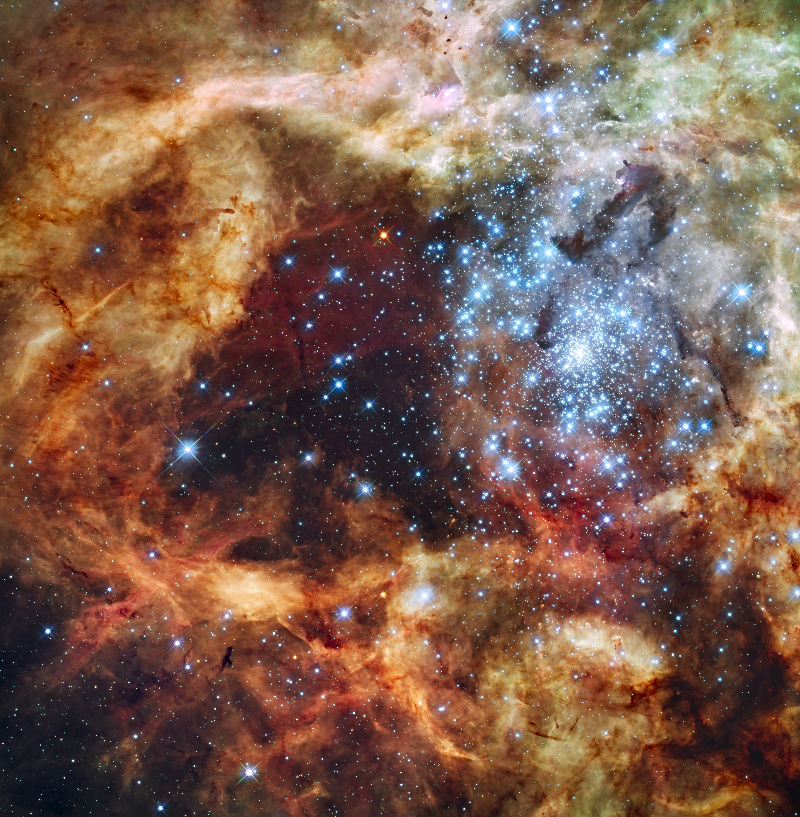
Credit: NASA, ESA, and F. Paresce (INAF-IASF, Bologna, Italy), R. O'Connell (University of Virginia, Charlottesville), and the Wide Field Camera 3 Science Oversight Committee

Credit: NASA, ESA, and F. Paresce (INAF-IASF, Bologna, Italy), R. O'Connell (University of Virginia, Charlottesville), and the Wide Field Camera 3 Science Oversight Committee
NGC 4755: The Kappa Crucis Cluster or The Jewel Box
The combination of images taken by three exceptional telescopes: the NASA/ESA Hubble Space Telescope, the ESO Very Large Telescope on Cerro Paranal, the MPG/ESO 2.2-metre telescope at ESO’s La Silla observatory has allowed the stunning Jewel Box star cluster to be seen in a whole new light.

This composite image serves as a still "zoom-in", showing the rich star field in which NGC 4755 nestles and then moving in to the detailed Hubble image of the Kappa Crucis Cluster, or Jewel Box, itself. Credit: ESO, NASA/ESA, Digitized Sky Survey 2 and Jesús Maíz Apellániz (Instituto de Astrofísica de Andalucía, Spain)
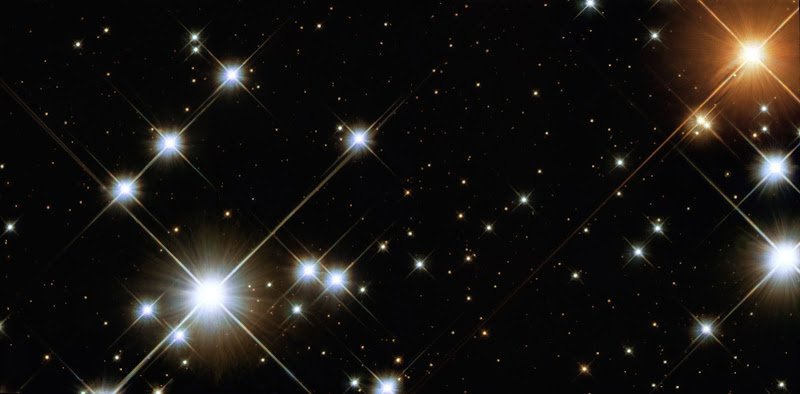
This image is a "close-up' view from the NASA/ESA Hubble Space Telescope of NGC 4755, or the Jewel Box cluster. Several very bright, pale blue supergiant stars, a solitary ruby-red supergiant and a variety of other brilliantly coloured stars are visible in the image, as well as many much fainter ones, often with intriguing colours. The huge variety in brightness exists because the brighter stars are 15 to 20 times the mass of the Sun, while the dimmest stars are less than half the mass of the Sun. This is the first image of an open galactic cluster with imaging extending from the far ultraviolet to the near-infrared. Credit: NASA/ESA and Jesús Maíz Apellániz (Instituto de Astrofísica de Andalucía, Spain)

The FORS1 instrument on the ESO Very Large Telescope (VLT) at ESO's Paranal Observatory was used to take this exquisitely sharp close up view of the colourful Jewel Box cluster, NGC 4755. The telescopes huge mirror allowed very short exposure times: just 2.6 seconds through a blue filter, 1.3 seconds through a yellow/green filter and 1.3 seconds through a red filter. The field of view spans about seven arcminutes. Credit: ESO
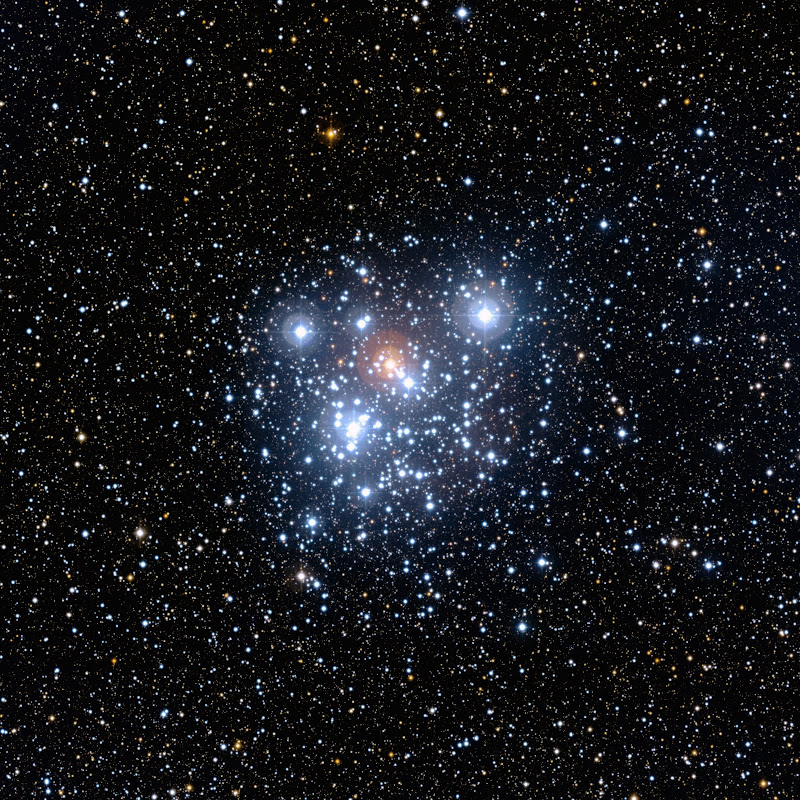
This image of the well-known NGC 4755 cluster or Jewel Box was taken with the Wide Field Imager (WFI) on the MPG/ESO 2.2-metre telescope at ESO's La Silla Observatory. It highlights the cluster and its rich surroundings in all their multicoloured glory. The field of view is 20 arcminutes across. The picture is based on images obtained through B, V and I filters. Credit: ESO

A wide-field image of the region around NGC 4755 constructed from the data from Digitized Sky Survey 2. The bright star is Mimosa, one of the main four stars in the Southern Cross. The darkness towards the bottom of the image is part of the Coal Sack, a vast area of obscuring dust easily visible to the unaided eye. The field of view is approximately 2.8 degrees x 2.9 degrees. Credit: ESO, ESA/Hubble and Digitized Sky Survey 2. Acknowledgment: Davide De Martin (ESA/Hubble)

This composite image serves as a still "zoom-in", showing the rich star field in which NGC 4755 nestles and then moving in to the detailed Hubble image of the Kappa Crucis Cluster, or Jewel Box, itself. Credit: ESO, NASA/ESA, Digitized Sky Survey 2 and Jesús Maíz Apellániz (Instituto de Astrofísica de Andalucía, Spain)

This image is a "close-up' view from the NASA/ESA Hubble Space Telescope of NGC 4755, or the Jewel Box cluster. Several very bright, pale blue supergiant stars, a solitary ruby-red supergiant and a variety of other brilliantly coloured stars are visible in the image, as well as many much fainter ones, often with intriguing colours. The huge variety in brightness exists because the brighter stars are 15 to 20 times the mass of the Sun, while the dimmest stars are less than half the mass of the Sun. This is the first image of an open galactic cluster with imaging extending from the far ultraviolet to the near-infrared. Credit: NASA/ESA and Jesús Maíz Apellániz (Instituto de Astrofísica de Andalucía, Spain)

The FORS1 instrument on the ESO Very Large Telescope (VLT) at ESO's Paranal Observatory was used to take this exquisitely sharp close up view of the colourful Jewel Box cluster, NGC 4755. The telescopes huge mirror allowed very short exposure times: just 2.6 seconds through a blue filter, 1.3 seconds through a yellow/green filter and 1.3 seconds through a red filter. The field of view spans about seven arcminutes. Credit: ESO

This image of the well-known NGC 4755 cluster or Jewel Box was taken with the Wide Field Imager (WFI) on the MPG/ESO 2.2-metre telescope at ESO's La Silla Observatory. It highlights the cluster and its rich surroundings in all their multicoloured glory. The field of view is 20 arcminutes across. The picture is based on images obtained through B, V and I filters. Credit: ESO

A wide-field image of the region around NGC 4755 constructed from the data from Digitized Sky Survey 2. The bright star is Mimosa, one of the main four stars in the Southern Cross. The darkness towards the bottom of the image is part of the Coal Sack, a vast area of obscuring dust easily visible to the unaided eye. The field of view is approximately 2.8 degrees x 2.9 degrees. Credit: ESO, ESA/Hubble and Digitized Sky Survey 2. Acknowledgment: Davide De Martin (ESA/Hubble)
Subscribe to:
Posts (Atom)